Buck Hollow Sporting Goods - click or touch to visit their website Midwest Habitat Company

Neonicotinoids insecticide & deer health- causing big problems???

Sligh1

Administrator
Staff member
Some is a repeat here. I truly believe EHD is the worst offender by far. Was just texting with Rob & Curtis on this. Rob had posted some things in past.
Seems like everyone out there is going “there’s something else going on”. IMO- not CWD. & nothing compared to ehd. But- I keep coming back to this. Probably not a lot a guy can do on this. Look at the timeframes as well as they really line up with some declines we’ve seen (yes, kill em all & ehd also in same timeframe). Gut tells me this could be part of the issues we seeing.
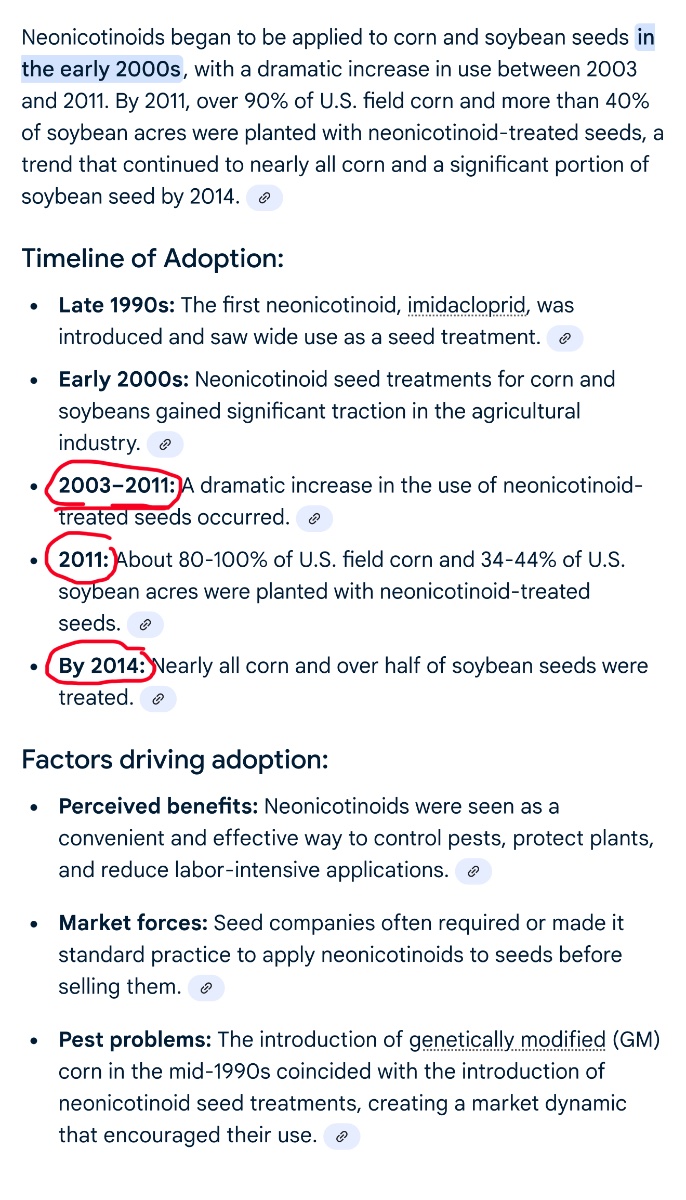
IMG_3853.jpeg

LINKS to read… I want you to google: Neonicotinoids, deer health
READ just a bit.

& posted before but very worth while & very good.
Thoughts?


Will watch the video tomorrow.

I've read a little bit about this topic over the past few years.
My take is, if there is a problem, it affects turkeys WAY more then deer.
 
I’ve been one on “the something else” bandwagon as posted on this site before. I have even made the comment that it appears reproductive on both deer and turkeys. No scientific backing but the article BH1983 suggests it could affect reproductive organs in deer. Wonder if it could also affect viability of songbird and turkey eggs?? I understand and concede that nest predators are a problem for turkeys BUT explain why I see smaller broods now per hen than back in the hay day of the turkeys in the early 2000s. The nest predators are not leaving a couple eggs per nest for the hen….
 
When we got hit in ‘21,’22, ‘23, and ‘24, we hadn’t had enough rain to make mud to make midge breeding grounds. All of our water holes dried up in ‘20 and according to what everyone says about EHD , ‘20 was the year we should’ve gotten smoked by it and we had zero EHD. I’ve been thinking for some time it was a water quality issue ( higher percentage of contaminants in what remaining water we had) and this neonicitinoids theory goes right along with that. It also seems like we didn’t get any deaths until after the soybeans lost their green leaves. ( I assume deer that were getting their moisture from the beans were forced to get their water from potentially contaminated water?) Also the “coyotes won’t eat them because they’re so hemorrhaged” I don’t buy that either, coyotes just can’t eat that many deer when it’s 90 degrees before they’re too rotten to eat.
 
I continue to be shocked by how many does have zero fawns in North MO. This is is a stark contrast to when I owned land in Wiscosonin where every doe had at least one.

We bought a farm in North MO in 2021 and have not shot a single doe, yet the population appears to be stable. I don't think the neighbors are gunning them down either. Predators make a dent for sure but it seems odd we aren't noticing an increase in anterless deer.
 
How long did it take to discover DDT was a problem and how long before we recovered from the damage done?

Excerpt from a Wiki page, FWIW: "Opposition to DDT was focused by the 1962 publication of Rachel Carson's book Silent Spring. It talked about environmental impacts that correlated with the widespread use of DDT in agriculture in the United States, and it questioned the logic of broadcasting potentially dangerous chemicals into the environment with little prior investigation of their environmental and health effects. The book cited claims that DDT and other pesticides caused cancer and that their agricultural use was a threat to wildlife, particularly birds. Although Carson never directly called for an outright ban on the use of DDT, its publication was a seminal event for the environmental movement and resulted in a large public outcry that eventually led, in 1972, to a ban on DDT's agricultural use in the United States."
 
This is why I don't like to use treated seed, or apply herbicide directly to what deer are consuming.

The last thing we need is more of our food sources contaminated with round up.

I think Kennedy is onto something here with Celiac's disease, etc.
 
Neonics could definitely be part of the problem.. I doubt they are the main/only problem tho. It kind of all goes together. Heavy corn/soybean rotation= less weeds, less bugs, less habitat diversity in general and obviously less habitat in general. No smoking gun here but death by a thousand cuts.
 
I continue to be shocked by how many does have zero fawns in North MO. This is is a stark contrast to when I owned land in Wiscosonin where every doe had at least one.

We bought a farm in North MO in 2021 and have not shot a single doe, yet the population appears to be stable. I don't think the neighbors are gunning them down either. Predators make a dent for sure but it seems odd we aren't noticing an increase in anterless deer.
I have been saying the same thing and also hunt n mo s Iowa. I pay attention to the number of fawns per doe and it is under 1:1 average and this area is thermal hunted pretty hard for predators.
 
I have been saying the same thing and also hunt n mo s Iowa. I pay attention to the number of fawns per doe and it is under 1:1 average and this area is thermal hunted pretty hard for predators.
Not so sure the thermal hunting isnt part of the problem. Sudden drop to deer quality in Iowa lines up perfectly with the popularity of thermal hunting. Coincidence? Maybe. Maybe not. I found a doe on my farm before season last year that was 100% shot my a rifle and of predator caliber.
 
Not so sure the thermal hunting isnt part of the problem. Sudden drop to deer quality in Iowa lines up perfectly with the popularity of thermal hunting. Coincidence? Maybe. Maybe not. I found a doe on my farm before season last year that was 100% shot my a rifle and of predator caliber.
24/7 surveillance of deer is totally an issue!! For every guy claiming that thermals/cell cams/trail cams in general help them pass up young deer there are 10 others targeting the very same deer they passed up.. if we really want some more deer to slip through the cracks and reach maturity we have to let the cracks get bigger. There are no cracks right now. Every buck is known even if the neighbors call him a different name.. this is the issue whether we want to admit it or not.
 
I’ve been one on “the something else” bandwagon as posted on this site before. I have even made the comment that it appears reproductive on both deer and turkeys. No scientific backing but the article BH1983 suggests it could affect reproductive organs in deer. Wonder if it could also affect viability of songbird and turkey eggs?? I understand and concede that nest predators are a problem for turkeys BUT explain why I see smaller broods now per hen than back in the hay day of the turkeys in the early 2000s. The nest predators are not leaving a couple eggs per nest for the hen….
FWIW, while an over population of raccoons and such can definitely be a detriment to ground nesting birds, I have way fewer nest predators now than I did back in the day when I had scads of turkeys. IMO, SOMETHING else is behind the precipitous drop in turk populations over the years.
 
I continue to be shocked by how many does have zero fawns in North MO. This is is a stark contrast to when I owned land in Wiscosonin where every doe had at least one.

We bought a farm in North MO in 2021 and have not shot a single doe, yet the population appears to be stable. I don't think the neighbors are gunning them down either. Predators make a dent for sure but it seems odd we aren't noticing an increase in anterless deer.
Southern Iowa here and I haven't been in the stand yet, but my son shot a "lone doe" Sunday evening. That is a sample size of one, admittedly, but it is something that we have seen much commonly in the recent past.
 
Not so sure the thermal hunting isnt part of the problem. Sudden drop to deer quality in Iowa lines up perfectly with the popularity of thermal hunting. Coincidence? Maybe. Maybe not. I found a doe on my farm before season last year that was 100% shot my a rifle and of predator caliber.
Not saying it is or isn’t an issue with thermal hunters killing deer because there is no doubt bad apples involved but I don’t see the number of poached deer like I did back in the hay day. We had a few guys that would drive around before thermal days and shoot 100 deer a night around the county while drinking beer. Not uncommon to see white belly’s from the road back then. Rarely see that now and don’t hear landowners talk about finding deer in the fields with bullet holes like I heard back in the day. My guess thermals not the issue in most places and in theory should be more than offsetting the few bad apples shooting deer by reducing predators.
 
I have been saying the same thing and also hunt n mo s Iowa. I pay attention to the number of fawns per doe and it is under 1:1 average and this area is thermal hunted pretty hard for predators.
24/7 surveillance of deer is totally an issue!! For every guy claiming that thermals/cell cams/trail cams in general help them pass up young deer there are 10 others targeting the very same deer they passed up.. if we really want some more deer to slip through the cracks and reach maturity we have to let the cracks get bigger. There are no cracks right now. Every buck is known even if the neighbors call him a different name.. this is the issue whether we want to admit it or not.
This is spot on. If he’s really big, assume EVERYONE within a square mile or more knows, has the same photos or videos. If he’s living on you or real close, don’t wait. Assume people will come literally out of the woodwork, knocking on doors in your neighborhood if they can to get a crack at him…that’s the current reality…
Interesting video and conversation about neonics, had never heard of them, I’ve been seeing more does without fawns, deer strangely having terrible coughing fits and watched our turkey population implode, sure makes you wonder…
 
Last edited:
Not so sure the thermal hunting isnt part of the problem. Sudden drop to deer quality in Iowa lines up perfectly with the popularity of thermal hunting. Coincidence? Maybe. Maybe not. I found a doe on my farm before season last year that was 100% shot my a rifle and of predator caliber.
Thermals are an issue in my hood, 100%! But…. The amount of dead deer & bucks we find for “no good reason” - too many IMO. I know what natural mortality is, I understand fighting, rutting hard, predator kills, etc Widespread - guys find way more “dead deer with no cause” than I think the natural mortality can explain.
 
I continue to be shocked by how many does have zero fawns in North MO. This is is a stark contrast to when I owned land in Wiscosonin where every doe had at least one.

We bought a farm in North MO in 2021 and have not shot a single doe, yet the population appears to be stable. I don't think the neighbors are gunning them down either. Predators make a dent for sure but it seems odd we aren't noticing an increase in anterless deer.
Same story to the east of you at my place in Illinois. I've harvested one doe on 200 acres since 2020. Expand that out to 600 acres and I estimate 1-2 does a year max, yet I see no additional deer accumulating on the properties. Good year this year for fawns per camera data, so we will see what transpires. I'm starting to question whether properties that are over 30% ag fields will ever over-populate with deer. Maybe its a social issue? Does running off other does?

The biggest mystery to me is why four year old bucks do not return once turning five. We will acquire footage in mid January of these bucks, seemingly healthy, that have been home bodies for multiple years, then gone once its time to harvest. Do these bucks die? Relocate once they turn 5? I only mention this because I could easily be convinced that there is some other source of mortality out there, beyond EHD/CWD/predators that is unknown or being overlooked.
 
Top Bottom